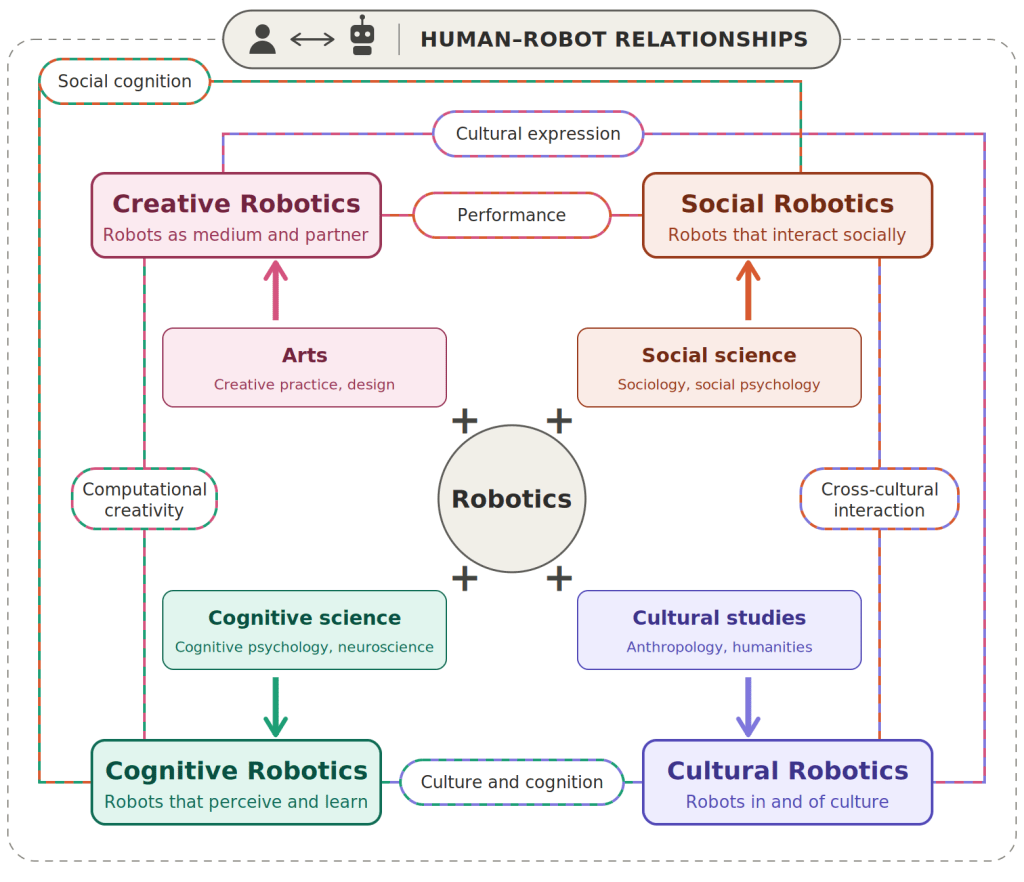
My research starts from the relationship between humans and robots, and it is interdisciplinary by necessity. I first opened this enquiry under the name Lovotics, asking what it might mean for a robot to be trusted, missed, cared for or even loved. Every robot is a meeting point between a person and a machine, and that relationship runs in both directions: people shape robots, and robots shape people. No single discipline can account for both sides of that meeting, so I now come at it through one shared core with four doors into it. Robotics sits at the centre, and what changes is the discipline it meets.
The arts, drawing on creative practice and design, give Creative Robotics, where the robot becomes both a medium and a partner, and where a relationship can be staged, played with and questioned. Social science, drawing on sociology and social psychology, gives Social Robotics, which asks how robots can interact with people in ways that feel natural, trustworthy and appropriate to the setting, whether a stage, a home or a hospital. Cultural studies, drawing on anthropology and the humanities, give Cultural Robotics, which looks at how robots are shaped by the cultures that build, adopt or resist them, and how they may in turn shape those cultures. Cognitive science, drawing on cognitive psychology and neuroscience, gives Cognitive Robotics, the study of robots that perceive, reason and learn through a body in a changing world, using AI methods to build that cognition.
These fields are not separate boxes, and much of the most interesting work happens where they meet. Creative and social robotics overlap in performance, where a machine shares a stage, a screen or a public space, and an audience, with people. Social and cognitive robotics overlap in social cognition, where the way people read intentions and emotions meets machines that seem to have minds of their own. Cultural and cognitive robotics meet in culture and cognition, how culture shapes the way both people and robots perceive and reason. Social and cultural robotics meet in cross-cultural interaction, where norms of politeness and trust differ from place to place. Creative and cognitive robotics meet in computational creativity, where machines generate art, music or ideas, and creative and cultural robotics meet in cultural expression, where robots take part in the stories, crafts and traditions of a community. Most of my projects sit in several of these overlaps at once. That is why I treat the four as one connected field of enquiry, and why I hold each of them as an open field, not a fixed set of outputs.
I treat the robots I work with, whether built from scratch or brought in as available platforms and reworked, reprogrammed and repurposed, not as finished pieces of engineering but as open questions: what does it mean for a body, however artificial, to move, express and relate within human life? For me, robotics is inseparable from questions long asked by philosophy and art: what constitutes agency, where the boundary between subject and object actually lies, and what forms of kinship, discomfort or wonder emerge when non-human things start to behave as though they have a will of their own. Drawing on posthumanist thought, which decentres the human as the sole measure of intelligence and agency, and on animist traditions that have long granted spirit and presence to objects, tools and machines, I ask what a genuinely relational robotics could look like, one that neither reduces the robot to a servant nor mistakes it for a person.
I work alongside artists, students and collaborators across all four fields, often in the same project: robots for theatre and live performance, robots that paint and draw, robots that write and deliver comedy, robots that move through choreography and dance, robots that make and respond to sound and music, and robotic works shown as sculpture and installation in gallery and exhibition settings. A robot that performs on stage has to read its audience, respond to what people do, and mean something different in each place it appears, so every performance, exhibition or public encounter is at once a creative, social, cognitive and cultural event, read and reinterpreted differently wherever it takes place. I also help build the field itself, through publications, events, workshops, books, special issues, conferences, the Creative Robotics Hub and various collaborations.
The process matters as much as the outcome, or even more. Much of this research lives in workshops, rehearsals, iterative prototyping, failed attempts and open-ended making, carried out with artists, research students and international collaborators, and often in dialogue with wider communities and audiences who encounter these robots on stage, in galleries, in clinics or in public space. Their responses, hesitations and unexpected readings become part of the research itself, not simply feedback on a finished product.
What links this research across its many forms, laboratory prototypes, staged performances, healthcare, therapeutic and service applications, is a refusal to treat robotics as a settled or purely technical field. Every robot I work with, alongside the artists, students and collaborators I work with, is offered as a small argument about what artificial life might yet become, and an invitation to keep asking, rigorously and often playfully, what it means to share the world with things we have made, or remade, in our own uncertain image.
Videos:
https://www.youtube.com/@hoomansamani
Publications:

