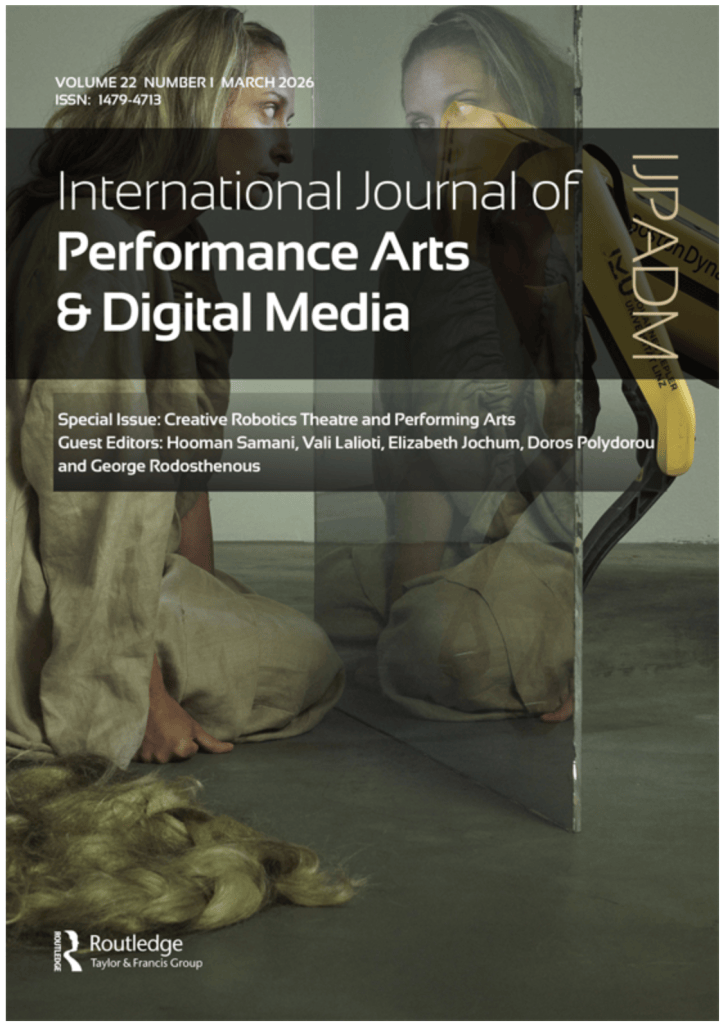
International Journal of Performance Arts and Digital Media
Special Issue on
Creative Robotics Theatre and Performance Arts
Special Issue Webpage: https://www.tandfonline.com/toc/rpdm20/22/1
Journal Website: https://www.tandfonline.com/journals/rpdm20
Special Issue Editors:
Hooman Samani, Creative Computing Institute, University of the Arts London
h.samani@arts.ac.uk
Vali Lalioti, University of the Arts London
v.lalioti@arts.ac.uk
Elizabeth Jochum, Aalborg University, RELATE Research Laboratory for Art and Technology
elizabethannjochum@gmail.com
Doros Polydorou, Cyprus University of Technology
doros.polydorou@cut.ac.cy
George Rodosthenous, School of Performance and Cultural Industries, University of Leeds
G.Rodosthenous@leeds.ac.uk
The special issue of the International Journal of Performance Arts and Digital Media (Vol. 22, Issue 1) explores “Creative Robotics Theatre and Performing Arts,” the emerging interdisciplinary field where robotics, artificial intelligence and live performance intersect. The collection treats robots not as mere tools or novelties, but as collaborators, co-performers and even vulnerable or ambiguous figures on stage. It examines themes such as touch and disability in human-robot dance encounters, the uncanny aesthetics of self-playing pianos, robotic misremembrance and historical erasure, empathy and presence in performing with machines, more-than-human dramaturgy, culturally adaptive robot comedians, and haptic feedback in immersive theatre. A recurring thread across the contributions is the value of resisting anthropomorphism and embracing robots’ otherness, including their materiality, constraints and idiosyncrasies, as a source of new aesthetic and relational possibilities, aligning the issue with broader posthumanist and new materialist thinking. Taken together, the issue demonstrates how live performance functions as a genuine research method for robotics and AI, offering a space to prototype interactions and probe the social, ethical and affective dimensions of human-machine relationships both on stage and beyond it.
Editorial
- Hooman Samani, Vali Lalioti, Elizabeth Jochum, Doros Polydorou & George Rodosthenous — “Creative Robotics Theatre and Performing Arts” (pp. 1–6)
Research Articles
- Sarah Whatley, Kate Marsh, Steve Benford, Rachael Garrett, Paul Tennent & Simon Castle-Green — “Touch, Agency and the Interplay between Dance, Disability and Robotics” (pp. 7–25)
- Irene Alcubilla Troughton — “Care and Alterity in Robotic Art: Mise-en-scène and Narratives as Framing Strategies for Human-Robot Encounters” (pp. 26–45)
- Kosmas Giannoutakis & Philippe Kocher — “The Unconcealed Machine: On the Aesthetics of the Klavierautomat” (pp. 46–67)
- Tak-Cheung Hui & Xiaoqiao Li — “Rings … Through Rings II: Frictional Historiography and Robotic Misremembrance” (pp. 68–90)
- Silke Grabinger — “The Triangle of HRoR Human–Robot–Recipient in Performing with Robots” (pp. 91–111)
- Petra Gemeinboeck, Audrey Rochette & Rob Saunders — “Difference-in-Resonance: The More-Than-Human Dramaturgy of AlloyedBodies and the Human–Robot Experience (HRX) Theatre” (pp. 112–143)
- Michael Wong Kam, Hooman Samani, Saina Akhond, Chinthaka Premachandra & Vali Lalioti — “Laughing Across Cultures: Culturally Sensitive Robotic Stand-up Comedian with Multimodal Expressiveness” (pp. 144–168)
- Zhining Jiang & Diana Alina Serbanescu — “Haptic Feedback Scenography in Environmental Theatre” (pp. 169–195)
Reviews
- Abbie Victoria Trott — “Experiential Spectatorship: Immersion, Participation, and Play During Times of Deep Mediatization”, by William W. Lewis (pp. 196–197)
- Cyrielle Garson — “AI, AR, and VR in Theatre and Performance: Technology in the Present and Future of Live Creative Arts”, by Shane Pike (pp. 197–199)
- Kate Maguire-Rosier — “Cultural Technologies: Robots and Artificial Intelligence in the Performing Arts”, edited by Yuji Sone and Richard Savery (pp. 199–201)
CFP (closed):
Creative Robotics Theatre and Performance Arts
This special issue aims to delve into the innovative integration of robotics and artificial intelligence in theatre and performance art, illuminating the transformative impact these technologies can have on live performances.
Scope and Themes
Creative Robotics Theatre represents a cutting-edge fusion of robotic technologies and theatrical performance. This special issue seeks comprehensive research, case studies, and theoretical discussions that showcase the diverse interactions between robotics and the performing arts.
We welcome submissions addressing, but not limited to, the following themes:
- Robotic Performance and Storytelling: Utilisation of robots as performers to enhance narrative and dramatic elements in theatre.
- Human-Robot Interaction in Theatre: Dynamics and collaboration between human actors and robotic performers on stage.
- Technological Innovations: Exploration of advanced robotics and AI technologies in theatre and performance.
- Creative Processes and Methodologies: Insights into the creative processes of designing, programming, and integrating robots in theatrical productions.
- Audience Engagement and Perception: Analysis of audience responses and engagement with robotic performers.
- Case Studies and Practical Applications: Documentation of specific creative robotics theatre productions and their outcomes, including application in other areas such as social robotics and healthcare.
- Ethical and Philosophical Considerations: Examination of the ethical implications and philosophical questions surrounding the use of robotics in theatre.
Topics of interest (including but not limited to):
- Creative robotics theatre
- Robotics performance and improvisation
- Embodied and tangible interfaces and performances
- Performance with embodied objects
- Technological embodiment in performance
- Human-robot theatre assemblages and storytelling
- Creative human-robot entanglements in performing arts
- Virtual/Remote theatrical playgrounds
- Drone performance
- Interactive storytelling with robots
- Robot choreography and dance performances
- Robotics in puppetry and marionette theatre
- Wearable technology and costumes in robotic performances
- Cultural and social implications of robotic theatre
- Ethics and human agency in creative human-robot entanglements
- Collaborative creation or devising processes in multi/inter/transdisciplinary robotic performance
- Sound design and music composition for robotic performances
- Adaptations of classic plays and literature with robotics
- Human-Robot Interaction in Performing Arts
- Entertainment robots and advancements in animatronics
- Theatrical results/potential by robots in other professional spheres/disciplines
- Interdisciplinary application of robotic performances in other domains
Background and Inspiration
Theatre and performance arts have poetically explored and incorporated robotics and immersive performance. In this special issue, we seek to explore, the intersection of robotics and theatre, through improvisation, physical storytelling, and interactive technologies that facilitate interactions between humans and non-human robotic entities within a physical space. This exploration invites important reflection on the complex relationship between humans and non-human entities, including robots, within our posthuman society, and on how the performance arts can inspire innovative thinking and creative problem-solving in robotics/AI research and act as a catalyst for exploring how interdisciplinary approaches can drive innovation in theatre and performance arts.
Submission Instructions
We invite scholars, practitioners, and researchers from diverse disciplines to submit their original contributions.
Please submit your manuscripts via the journal’s online submission system, selecting the special issue title “Creative Robotics Theatre and Performance Arts”.
Please note that IJPADM invites the submission of Documents and Research Articles, to allow for more creative ways of submitting practice-based research in our area. For this special issue, Documents can take different forms such as shorter performance essays, pictorials, interviews, annotated scripts, videos, accounts of process, practice reports, and so on. We would normally expect Research Articles to be 7-8,000 words long. Documents can be of any length suitable to the format, though we would not normally be publishing submissions longer than 8,000 words unless a clear justification is provided.
Publication Planning Schedule
| Stage | Description | Target Date |
| Call for Papers Released | Announcement | Feb 2025 |
| Submission Deadline | Final date for submission | 30th June 2025 |
| Final Revisions Due | Final manuscript submission deadline | 2026 |
| Publication | Special Issue live | 2026 |

